Best SaaS Boilerplates in 2026: Next.js Starter Kits Compared
An honest comparison of 8 SaaS boilerplates and Next.js starter kits in 2026. Features, pricing, AI integrations, and what actually matters when picking one.
 FekriMarch 24, 20263 min read
I've been building with SaaS boilerplates since 2023. I also built one (AnotherWrapper). So yes, I'm biased. But I've also used, tested, or dug through the code of most boilerplates on this list. I'll be upfront about where AnotherWrapper fits and where something else might work better for you.
This is the comparison I wish existed when I started.
What Is a SaaS Boilerplate?
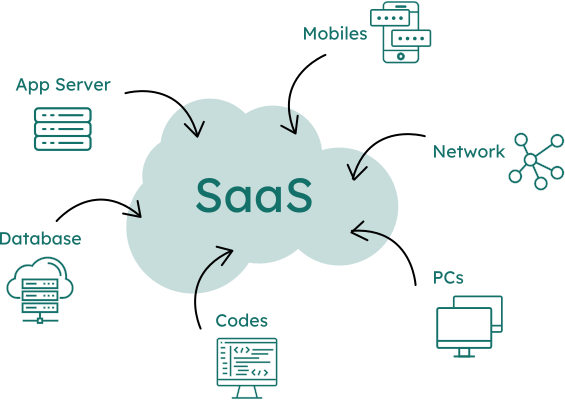
A SaaS boilerplate is a pre-built codebase that gives you auth, payments, database, email, and deployment out of the box. Instead of spending 4-6 weeks wiring up Stripe webhooks, session management, and email flows, you clone a repo and start building your actual product.
The good ones save you weeks. The bad ones cost you weeks debugging someone else's code.
The best boilerplates in 2026 go beyond just auth + payments. They include AI integrations, analytics, file storage, and production-ready demo apps you can customize or strip out.
What Actually Matters When Picking a Boilerplate
Most comparison articles list features in a table and call it a day. That's not how you actually make this decision. Here's what to prioritize:
1. Does it match your stack?
If you're a Next.js developer, don't buy a Django boilerplate because it has more features. You'll fight the framework instead of building your product. Most boilerplates in 2026 are Next.js + TypeScript + Tailwind CSS. That's the stack that won.
2. How's the auth?
Auth is the thing that breaks at 2am. Check which provider they use (Better Auth, Clerk, NextAuth, Supabase Auth, custom), whether it supports OAuth + magic links + email/password, and how session management works. If you have to roll your own password reset flow, that's a red flag.
3. How many payment providers?
Some boilerplates only support Stripe. That's fine if you're US/EU-based. But if you need Polar or LemonSqueezy for different regions or tax handling, check first. Rewiring payment logic later is painful.
4. AI integrations (if applicable)
If you're building an AI product, check how many providers are supported and whether the boilerplate uses Vercel AI SDK or raw API calls. Multi-provider support (OpenAI, Anthropic, Google, xAI, Groq, DeepSeek) means you can switch models without rewriting your backend.
5. Demo apps vs empty shell
Some boilerplates give you a blank canvas with infrastructure. Others give you working apps you can modify. Both approaches have merit. Working apps are faster to ship. Blank canvases are cleaner to customize.
The 8 Best SaaS Boilerplates in 2026
1. AnotherWrapper
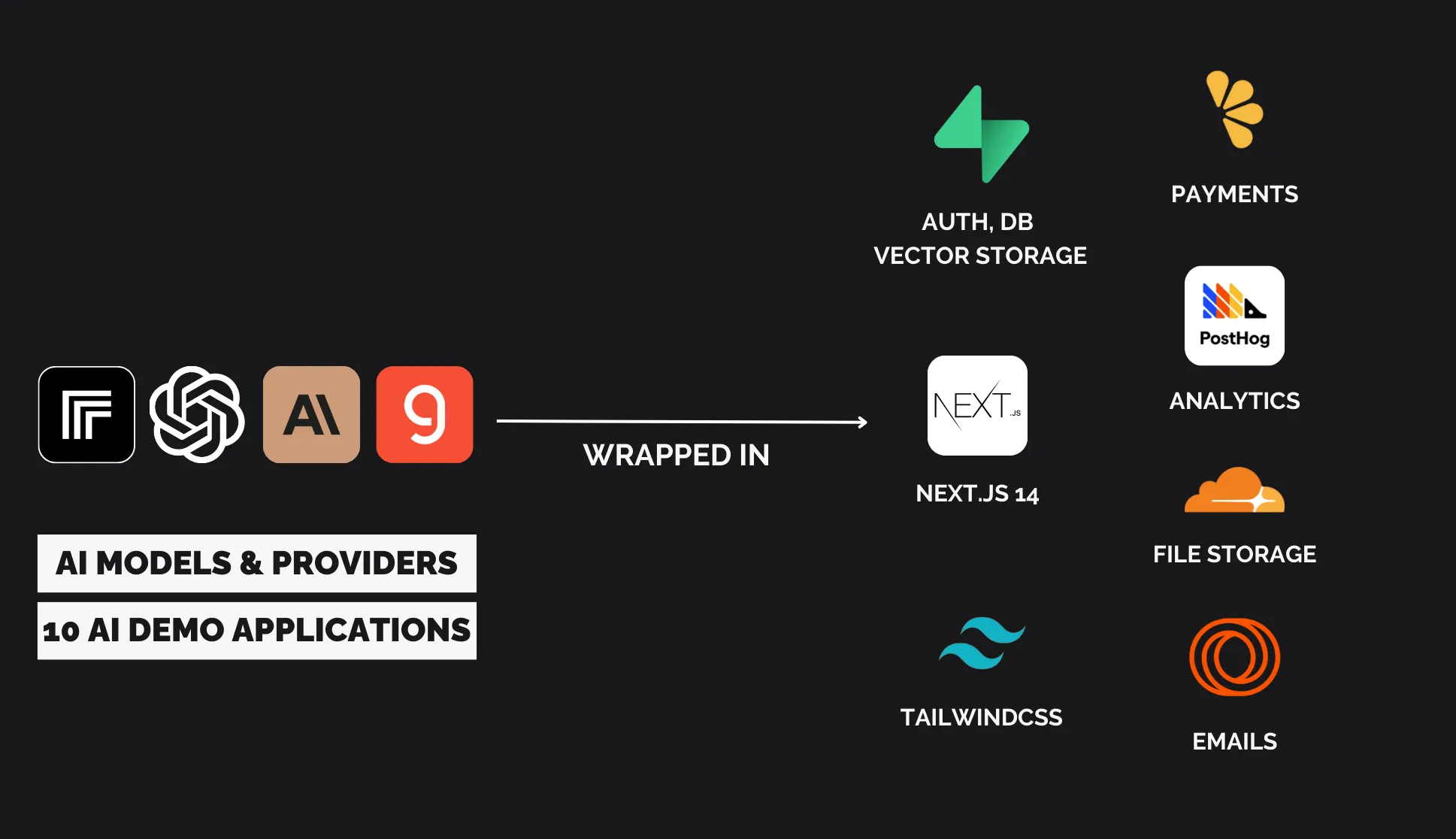
Stack: Next.js 16 / React 19 / TypeScript / Tailwind CSS / Drizzle ORM / PostgreSQL
Pricing: $249 (Solo) / $549 (Startup, 5 seats) / $999 (Agency, 10 seats) - one-time, lifetime access
Full disclosure: I built this one. So I know exactly what's in it and what's not.
AnotherWrapper ships with 8 production-ready AI apps: multi-model chat with RAG and PDF processing, image generation (GPT-Image-1, Flux, Imagen-4, Ideogram, Recraft), video generation (Sora 2, Veo 3, Kling 2.6), voice synthesis via ElevenLabs, audio transcription via Whisper, a calorie tracker with vision AI, a marketing plan generator, and a Product Hunt launch simulator.
Each app is a complete vertical slice: UI, API routes, database schema, credit system, file storage. You can ship any of them as a standalone product or use them as reference implementations for your own app.
What's included beyond AI apps:
- Auth: Better Auth with email/password, Google OAuth, magic links, password reset
- Database: Drizzle ORM with PostgreSQL + pgvector for embeddings
- Payments: Stripe, Polar, and LemonSqueezy. Provider-agnostic architecture, swap with 1 env var
- Email: Resend, Loops, or Brevo. Same provider-agnostic pattern
- Analytics: PostHog, Plausible, or DataFast
- Storage: S3-compatible (Cloudflare R2 recommended) for images, videos, audio, PDFs
- Monitoring: Sentry integration
- Credit system: Per-generation metering with atomic reservation, refund on failure
- RAG pipeline: PDF upload, chunking, OpenAI embeddings, pgvector similarity search with citations
- AI providers: OpenAI (GPT-5, o3), Anthropic (Claude Opus 4.5, Sonnet 4.5), Google (Gemini 3), xAI (Grok 4), Groq (Llama 4), DeepSeek. All via Vercel AI SDK
- Developer experience: Bootstrap CLI for setup, Drizzle Studio, Turbopack dev server, AGENTS.md for AI-assisted development with Cursor and Claude Code
Best for: Developers building AI-powered products who want working reference apps, not just infrastructure. Also works well for "vibe coding" with Cursor or Claude Code since it ships with AGENTS.md documentation.
Honest take: It's the most feature-complete option if you're building anything AI-related. The trade-off is complexity: 8 apps means a lot of code. If you're building a simple todo app, this is overkill.
Here's a preview of what you get. These are UI mockups, but they're close to the actual apps:
Want to see the real thing? Try the live demos →
2. ShipFast
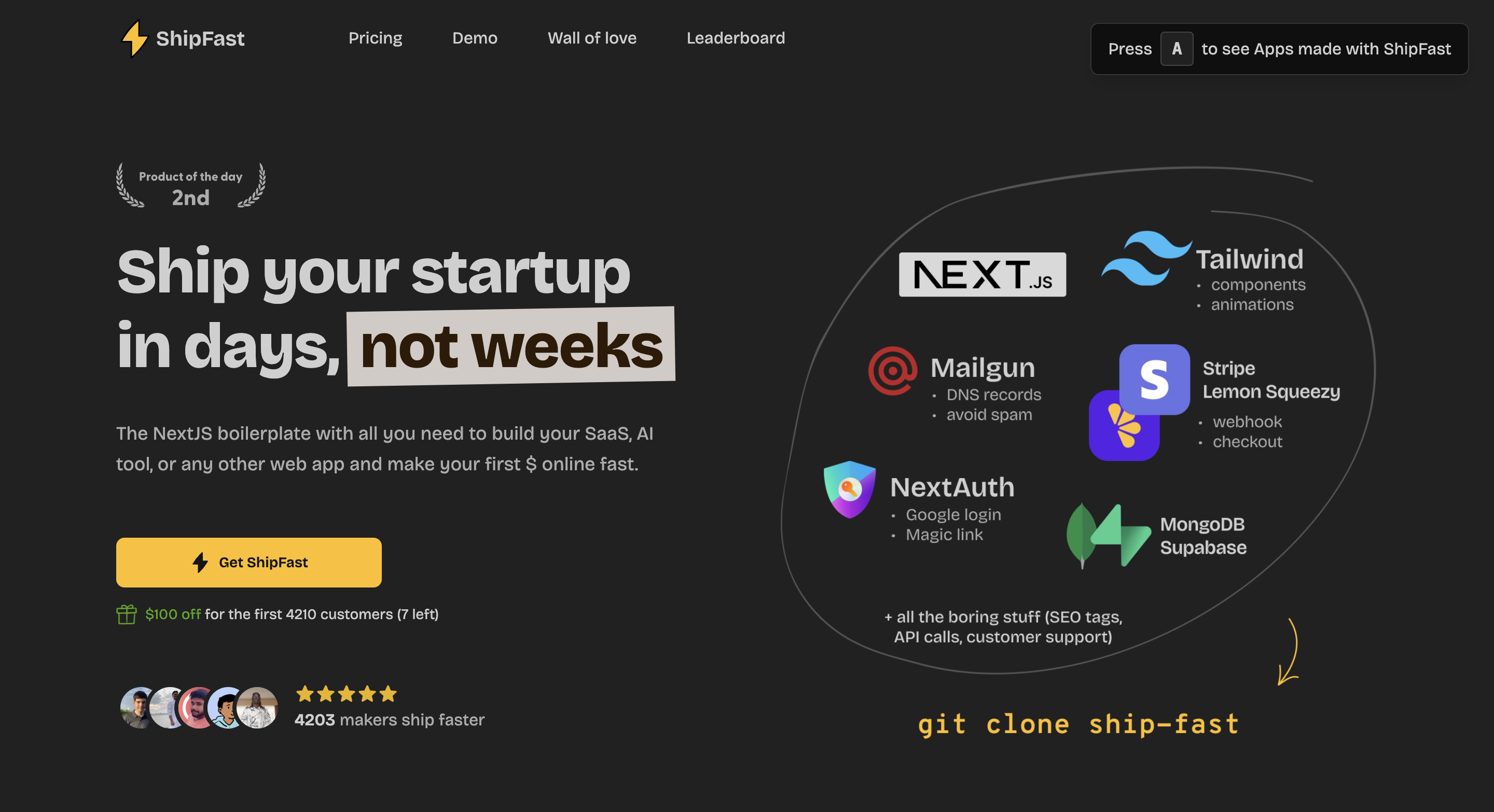
Stack: Next.js / TypeScript / Tailwind CSS / NextAuth / MongoDB or Supabase
Pricing: $199 (Starter) / $299 (All-in) - one-time
Built by Marc Lou, who's probably done more for the "ship fast" movement than anyone. ShipFast is the OG Next.js SaaS boilerplate that inspired a lot of what came after.
It gives you auth, Stripe payments, transactional emails via Mailgun, SEO optimization, and a clean blog system. The code is straightforward and well-documented. No AI magic. Just solid SaaS infrastructure.
Best for: Traditional SaaS products (dashboards, subscription apps, marketplaces) where you don't need AI integrations. Solo developers who want minimal code to understand and extend.
Honest take: Great starting point if you don't need AI. The community is huge. But the architecture hasn't changed much since 2024, and some choices (like MongoDB as default) feel dated compared to newer options using PostgreSQL + Drizzle.
3. Makerkit
Stack: Next.js or Remix / TypeScript / Tailwind CSS / Supabase or Firebase
Pricing: $249 (Indie) / $499 (Team) / $999 (Enterprise) - one-time + 1 year updates
Makerkit stands out for flexibility. You pick your framework (Next.js or Remix) and your database (Supabase or Firebase). It includes team management, role-based access control, and a proper multi-tenant architecture from day 1.
It also has AI integrations (chatbots, text editors) but they're more of an add-on than the core product.
Best for: B2B SaaS products that need multi-tenancy, team invites, and role-based permissions. If you're building something where organizations have multiple users with different access levels, Makerkit handles that well.
Honest take: Strong on B2B features that others don't have. The dual framework support (Next.js + Remix) is nice but means the docs can feel split. The Firebase option feels like a legacy path at this point.
4. Supastarter
Stack: Next.js or Nuxt / TypeScript / Tailwind CSS / Supabase or Prisma
Pricing: $299 (Starter) / $499 (Team) - one-time
Supastarter is the one to look at if you're a Vue developer (they have a Nuxt version) or if you're deep in the Supabase ecosystem. Clean architecture, solid docs, and i18n built in from the start.
They recently added AI features but the core value is still the SaaS infrastructure: auth, billing, team management, admin panel, and a nice landing page kit.
Best for: Teams that want Vue/Nuxt support, projects requiring internationalization (i18n) from day 1, or developers who want a polished admin dashboard out of the box.
Honest take: The Nuxt version is genuinely unique. No other boilerplate on this list supports Vue/Nuxt. If that's your stack, there's no competition. The Next.js version is solid but faces stiffer competition.
5. OpenSaaS (Wasp)
Stack: Wasp framework / React / Node.js / Prisma / PostgreSQL
Pricing: Free and open source
The free option on this list. OpenSaaS is built on Wasp, a full-stack framework that generates React + Node.js code from a declarative config. You get auth, Stripe, analytics, email, and an admin dashboard.
Being open source means you can see exactly what you're getting. The community is active and the docs are good. The trade-off is that you're adopting the Wasp framework, which is an additional abstraction layer.
Best for: Developers who don't want to pay for a boilerplate, or who want the safety of open-source code they can audit. Also good for learning how SaaS infrastructure works.
Honest take: You can't beat free. The Wasp framework is interesting but niche. If you're already comfortable with Next.js, learning Wasp is an extra step. But for someone starting fresh, it's a legitimate option.
6. SaaS Pegasus
Stack: Django / Python / HTMX or React / PostgreSQL
Pricing: $249 (Personal) / $499 (Business) / $999 (Unlimited) - one-time
The Python option. If your team writes Python and you don't want to learn Next.js, SaaS Pegasus is probably what you want. It's been around since 2020 and is the most mature Django SaaS boilerplate.
Includes auth, Stripe, teams, roles, admin panel, background tasks via Celery, and recently added AI/LLM integrations. The HTMX option is interesting if you want server-rendered pages without a heavy JS frontend.
Best for: Python/Django developers who don't want to context-switch to JavaScript. Data-heavy applications where Python's ecosystem (pandas, numpy, scipy) is a real advantage.
Honest take: If you're a Python shop, nothing else on this list comes close. But if you're choosing a stack from scratch in 2026, Next.js has a larger ecosystem for SaaS specifically. SaaS Pegasus is the right choice if Python is a hard requirement.
7. SaaSBold
Stack: Next.js / TypeScript / Tailwind CSS / Prisma / PostgreSQL
Pricing: $149 (Starter) / $249 (Growth) / $499 (Business) - one-time
The budget option from the team behind NextJSTemplates. SaaSBold gives you a clean starting point with auth (NextAuth), Stripe, email, blog, and 25+ pre-built pages. The landing page templates are well-designed.
It doesn't have AI integrations or team management, but if you need a simple, affordable starting point with good UI components, it gets the job done.
Best for: Developers on a budget who want solid UI components and landing page templates. Simple SaaS products that don't need AI or multi-tenancy.
Honest take: Best value per dollar on this list. The UI templates alone save you design time. But you'll need to build more from scratch compared to pricier options.
8. Wrapfa.st
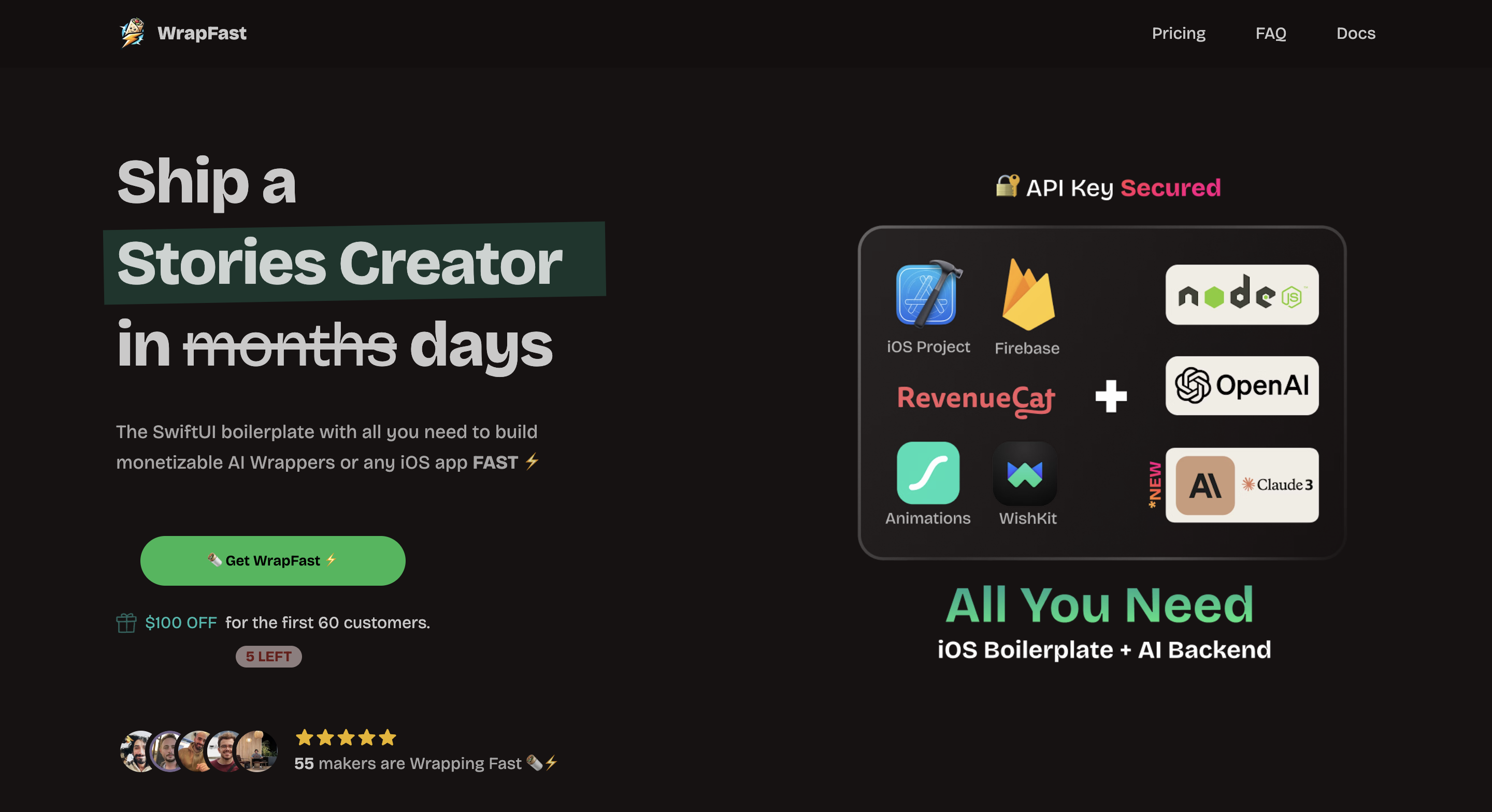
Stack: SwiftUI / iOS / StoreKit
Pricing: $229 (Standard) - one-time
The iOS wildcard. If you're building a native iOS app, Wrapfa.st is the only boilerplate on this list that targets Apple's ecosystem. SwiftUI, StoreKit for in-app purchases, OpenAI integration, and App Store optimized onboarding flows.
Best for: iOS developers building AI-powered mobile apps for the App Store. If your product is mobile-first, this saves months of iOS boilerplate.
Honest take: Completely different from everything else on this list. There's no comparison because nobody else does iOS SaaS boilerplates well. If you're building for iOS, this is it.
Feature Comparison Table
| Feature | AnotherWrapper | ShipFast | Makerkit | Supastarter | OpenSaaS | SaaS Pegasus | SaaSBold |
|---|---|---|---|---|---|---|---|
| Framework | Next.js 16 | Next.js | Next.js/Remix | Next.js/Nuxt | Wasp (React) | Django | Next.js |
| Auth | Better Auth | NextAuth | Supabase/Firebase | Supabase | Wasp Auth | Django Auth | NextAuth |
| Database | PostgreSQL + Drizzle | MongoDB/Supabase | Supabase/Firebase | Supabase/Prisma | PostgreSQL + Prisma | PostgreSQL | PostgreSQL + Prisma |
| Payments | Stripe, Polar, LemonSqueezy | Stripe | Stripe, LemonSqueezy | Stripe, LemonSqueezy | Stripe | Stripe | Stripe |
| AI integrations | 6+ providers, 8 demo apps | Basic OpenAI | Basic AI chat | Basic AI features | None built-in | Basic LLM | None |
| Team management | No | No | Yes (RBAC) | Yes | No | Yes | No |
| i18n | No | No | Yes | Yes | No | Yes | No |
| Open source | No | No | No | No | Yes | No | No |
| Price (entry) | $249 | $199 | $249 | $299 | Free | $249 | $149 |
Quick Decision Guide
Building an AI product? AnotherWrapper. 8 working AI apps, 6+ LLM providers, RAG pipeline, credit system. Nothing else comes close for AI.
Building B2B with teams? Makerkit. Multi-tenancy and RBAC are built in, not bolted on.
Need Vue/Nuxt? Supastarter. It's the only good Nuxt SaaS boilerplate.
On a budget? OpenSaaS (free) or SaaSBold ($149).
Python developer? SaaS Pegasus. Don't fight the stack.
Building for iOS? Wrapfa.st. There's no real alternative.
Traditional web SaaS? ShipFast. Proven, simple, huge community.
AI Integration: Why It Matters in 2026
Every other SaaS product launching today has some AI component. Even if your core product isn't AI, you'll probably want AI-powered search, summarization, or content generation somewhere in your app.
Here's what "AI integration" actually means in practice:
Multi-provider support means you're not locked into OpenAI. When Anthropic releases something faster or Google drops prices, you swap a model string. AnotherWrapper supports OpenAI (GPT-5, GPT-5 Mini, o3), Anthropic (Claude Opus 4.5, Sonnet 4.5, Haiku 4.5), Google (Gemini 3 Pro, Flash), xAI (Grok 4, 4.1), Groq (Llama 4), and DeepSeek. All through Vercel AI SDK, so the interface is identical.
RAG (Retrieval-Augmented Generation) lets users upload documents and chat with them. It sounds simple but the pipeline is complex: PDF extraction, text chunking, embedding generation, vector storage (pgvector), similarity search, and citation tracking. Building this from scratch takes 2-3 weeks minimum.
Credit systems let you monetize AI usage. Users buy credits, each generation costs X credits, failed generations get refunded. AnotherWrapper handles this with atomic database operations so you never over-charge.
Image and video generation are becoming table stakes. GPT-Image-1, Flux, Imagen-4 for images. Sora 2, Veo 3, Kling for video. These require async processing, file storage, and gallery management. AnotherWrapper includes all of this with working UIs.
Deployment and Infrastructure
All Next.js boilerplates on this list deploy to Vercel with zero config. The real questions are about what runs alongside your app:
Database: PostgreSQL is the 2026 standard. If your boilerplate uses MongoDB, you'll eventually want to migrate. Drizzle ORM is gaining ground over Prisma for type-safe queries with less overhead. Supabase provides hosted PostgreSQL with extras (realtime, edge functions, storage).
File storage: S3-compatible storage (Cloudflare R2, AWS S3, Backblaze B2) for user uploads, generated images, videos, and audio. R2 has no egress fees, which matters when you're serving AI-generated images.
Email: Resend is the developer favorite. Loops for marketing automation. Brevo for high volume. Most boilerplates let you swap providers.
Analytics: PostHog for product analytics and session replay. Plausible for privacy-first page analytics. Both are solid.
The Cost Reality
The boilerplate price is the smallest cost. Here's what actually adds up:
- AI API calls: $50-500/month depending on model and volume. GPT-5 is ~$10/M input tokens. Claude Opus 4.5 is ~$15/M. Image generation is $0.02-0.08 per image.
- Database hosting: $0-25/month (Supabase free tier, Neon free tier, or Railway at $5/month)
- Vercel hosting: $0-20/month (free tier is generous for most early-stage apps)
- File storage: $0-5/month for R2 (free tier covers most early usage)
- Domain + email: $10-15/year
Total monthly cost to run an AI SaaS in 2026: roughly $50-100/month at low scale. The boilerplate is a one-time cost that saves you 4-8 weeks of development time. At any reasonable hourly rate, every boilerplate on this list pays for itself in the first week.
Frequently Asked Questions
What's the best SaaS boilerplate for beginners?
ShipFast or SaaSBold. Both have clean codebases that are easy to understand. ShipFast has the largest community, so you'll find answers to most questions on Reddit or their Discord. If you're a complete beginner, OpenSaaS is free and lets you learn without any financial risk.
Is it worth paying for a SaaS boilerplate when free options exist?
Yes, for most developers. OpenSaaS is good but limited. Paid boilerplates save you 100+ hours of integration work. If your time is worth more than $2/hour, any paid boilerplate on this list is a good deal. The real cost isn't the boilerplate. It's the months of building infrastructure instead of your actual product.
Which boilerplate has the best AI integrations?
AnotherWrapper, and it's not close. 8 production-ready AI apps, 6+ LLM providers, RAG with PDF processing, image generation (5+ models), video generation (4 models), voice synthesis, audio transcription. Other boilerplates have basic OpenAI chat at most.
Can I use a SaaS boilerplate for a non-AI product?
Every boilerplate on this list works for non-AI products. You get auth, payments, database, and email regardless. The AI features are just extra. AnotherWrapper's provider-agnostic architecture for payments, email, and analytics is useful even if you strip out all AI code.
Next.js or Django for a SaaS in 2026?
Next.js has a larger SaaS ecosystem: more boilerplates, more component libraries, better Vercel deployment, and React's hiring pool is bigger. Django is better if your team already writes Python or if your product is data-heavy (ML pipelines, data processing). There's no wrong answer, but if you're starting from zero, Next.js gives you more options.
What's the difference between a boilerplate and a starter kit?
Same thing, different name. "Boilerplate" implies more pre-built code. "Starter kit" implies a lighter starting point. In practice, most products on this list call themselves both interchangeably.
How do I evaluate a SaaS boilerplate before buying?
Check the demo apps (most offer live demos). Read the docs. Look at the changelog to see how often it's updated. Check their Discord or community for activity. A boilerplate that hasn't been updated in 6 months is probably abandoned.
Do SaaS boilerplates support Stripe, LemonSqueezy, and Polar?
Most support Stripe. A few support LemonSqueezy. AnotherWrapper is the only one on this list that supports all 3 (Stripe, LemonSqueezy, and Polar) with a provider-agnostic architecture. You switch payment providers by changing an env variable.
Which Next.js boilerplate is best for building with Cursor or Claude Code?
AnotherWrapper ships with AGENTS.md documentation specifically designed for AI-assisted development. The modular architecture means AI coding tools can understand and modify individual features without breaking others. If you're doing AI-assisted development ("vibe coding"), this matters more than you'd expect.
How long does it take to launch a SaaS with a boilerplate?
Depends on your product complexity. For a simple AI wrapper: 1-2 weeks with AnotherWrapper (you're mostly customizing existing apps). For a traditional SaaS: 2-4 weeks with any boilerplate on this list. For something complex with custom features: 4-8 weeks. Without a boilerplate, multiply those numbers by 3-4x.
Last updated: March 2026. I'll keep this article current as boilerplates evolve. If I missed a boilerplate you think belongs here, reach out.
Stay ahead of the curve
Weekly insights on AI tools, comparisons, and developer strategies.

Fekri
Building tools for the next generation of AI-powered startups. Sharing what I learn along the way.
Continue reading
You might also enjoy

The best SaaS Boilerplates to build your SaaS in 2024
Your Ultimate Guide to Speedy SaaS Development
 Fekri
Fekri
Stripe Integration Guide: Building Payment Flows for SaaS
Learn how to implement both one-time payments and subscription flows with Stripe in your SaaS application.
Fekri
SaaS Payment Providers: The Ultimate Comparison Guide
A concise comparison of Stripe, Lemon Squeezy, Polar, and Creem for SaaS businesses looking for the ideal payment solution.
Fekri